A group can arrive at the same address and still have a disorganized start. One guest is waiting for luggage, another has landed at a different terminal, and the venue schedule cannot move. Group transport works best when it is planned as part of the itinerary, not arranged as an afterthought.
For a family celebration, a visiting delegation, a conference team, or guests traveling between Copenhagen Airport and a hotel, the goal is simple: everyone should know where to be, when to be there, and who is responsible if plans change. The right transport setup replaces a chain of separate bookings with one clear plan.
What reliable group transport should solve
Moving several people is not simply a matter of booking a larger vehicle. It is coordination: arrival times, luggage volume, pickup access, passenger comfort, waiting time, and the order of stops all affect the experience.
A well-managed arrangement gives the organizer one point of contact and the group a clear meeting plan. That is especially valuable when guests are unfamiliar with the area, have limited time between appointments, or need to arrive together. Instead of calling multiple drivers or tracking several taxis, the organizer can focus on the event, meeting, or journey ahead.
The most dependable solution also makes the price clear before the day begins. A fixed total price provides a useful level of control for companies, families, and event organizers. No taximeter. No surprises.
Start with the itinerary, not the vehicle
The vehicle matters, but it should follow the itinerary. Before choosing between a van, minibus, or coach, establish the practical details of the trip.
How many passengers are traveling at each stage? A group of 20 may become a group of 12 after an airport drop-off, while luggage requirements may be highest only on the first journey. Are all passengers leaving from one place, or are there several pickup addresses? Is the group traveling directly to a destination, or will the schedule include dinner, meetings, sightseeing, or multiple venues?
Timing deserves the same attention. For airport arrivals, include time for disembarkation, baggage collection, customs, and the possibility that travelers emerge at different times. For events, build in a reasonable arrival window rather than aiming for the exact minute doors open. The most polished transportation plan has room for normal delays without making the group feel rushed.
A professional coordinator should ask these questions before confirming the booking. They are not unnecessary formalities. They prevent the common problems that make group travel feel chaotic: insufficient seating, too little luggage capacity, unclear meeting points, and drivers receiving incomplete information.
Passenger count is only the first number
A vehicle with enough seats may still be the wrong choice. A group of eight carrying only briefcases has very different needs from eight travelers with large suitcases, garment bags, strollers, or exhibition materials.
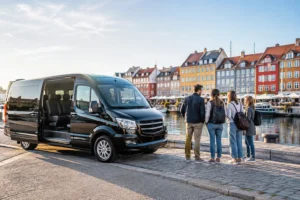
It also helps to consider the makeup of the group. Guests who have just completed a long-haul flight may appreciate the extra room and easy access of a spacious Mercedes van. Larger groups traveling together to a venue may be better served by a minibus or coach, where everyone departs and arrives as one party.
With a fleet ranging from electric Mercedes EQE sedans and EQV vans to minibuses and coaches for up to 75 passengers, SkyLimousine can match capacity to the actual journey rather than forcing the group into a one-size-fits-all solution.
Choose the right setup for the group
For smaller groups, a premium van is often the practical choice. It keeps colleagues, relatives, or guests together while providing space for bags and a more relaxed transfer than several separate cars. It is particularly useful for airport arrivals, hotel departures, and point-to-point journeys where keeping everyone together matters.
A minibus is a strong fit for medium-sized groups, such as conference attendees, wedding guests, sports teams, or company departments moving between locations. The benefit is not only capacity. A single departure time, one arrival point, and one chauffeur team make the schedule easier to manage.
For major events, large delegations, and extensive guest logistics, a coach may be the most efficient option. Coaches can accommodate groups of up to 75 passengers and reduce the number of vehicles arriving at a venue. That can be decisive at locations with limited curb access, narrow arrival windows, or strict event security procedures.
There is a trade-off to consider. One large vehicle creates a simple shared schedule, but it may require passengers to wait for the full group. Several smaller vehicles offer more flexibility, particularly if guests arrive on different flights or stay at different hotels. The best answer depends on whether togetherness or individual flexibility is the higher priority.
Airport group transport needs a clear meeting plan
Airport pickups are where small assumptions become expensive delays. “Meet outside” is not a sufficient instruction for a group arriving in an unfamiliar airport. Travelers need to know the meeting location, who will meet them, what name or sign to look for, and what to do if a flight is delayed.
For Copenhagen Airport, a planned pickup should account for terminal details and live arrival information. If passengers are landing on separate flights, it may be sensible to arrange an appropriate waiting period or schedule staggered departures. If everyone arrives together but luggage is extensive, vehicle loading should be considered in the timing.
The return journey deserves equal care. Confirm the departure time based on the airline’s recommended arrival time, expected traffic conditions, and the group’s readiness. For a group, one late passenger can affect everyone. A clear collection time and a named coordinator on site help avoid uncertainty.
One contact person changes the experience
When the transport involves multiple stops, changing arrival details, or a large number of travelers, a single accountable contact is valuable. The organizer should not have to repeat the itinerary to different people throughout the process.
A dedicated contact person can confirm passenger numbers, update timing, communicate special requests, and keep the chauffeur team informed. This is also useful for international visitors, whose flight details or local schedules may change while they are already en route.
Clear communication is a form of service. It makes guests feel expected rather than processed.
Details that should be confirmed before booking
The most effective group transportation bookings are specific. Provide the date, pickup time, addresses, number of passengers, expected luggage, and the destination or full route. If there are flight numbers, event schedules, multiple pickup points, accessibility needs, or children traveling, include those details at the outset.
It is also wise to identify the person authorized to make last-minute decisions. This may be an event manager, travel coordinator, family member, or office assistant. Their phone number should be available to the transport coordinator, while the group should receive simple, consistent instructions rather than several competing messages.
Ask for the full price before confirmation and make sure it covers the agreed itinerary. If the journey may change – for example, an additional stop is possible or the group may need to wait during an event – discuss that scenario in advance. Transparency is not just about the original quote. It is about knowing how adjustments will be handled if the day develops differently.
Comfort and discretion are operational details
For many groups, transportation is the first and last impression of a visit to Denmark. A clean, well-presented vehicle, a professional chauffeur, and calm assistance with luggage set the tone before the first meeting or event begins.
Discretion matters just as much. Business discussions, personal conversations, and high-profile guests do not need unnecessary attention. Chauffeurs should be courteous and available while allowing passengers the space to prepare, rest, or speak privately.
Comfort also supports punctuality. When passengers travel together in an appropriate vehicle, they arrive less fragmented and better prepared. That has practical value for a board meeting, a private dinner, a cruise departure, or a full-day program across Zealand.
The best group transport is rarely the part of the day people talk about most. It is the part that lets every other part of the day happen on schedule, with the right people in the right place and no avoidable uncertainty. Share the itinerary early, confirm the details clearly, and let one experienced coordinator carry the logistics.